
The Importance of Eye Care
Your eye sight is one of your most important senses and it is estimated that 80% of what we perceive comes through our sense of sight. It is important to protect your eyesight to ensure many more years of enjoying your vision.
By protecting your eyes and regular eye examinations you will reduce the odds of vision loss and the risk of developing untreated eye disease for the rest of your life.
Myopia (Near sighted)
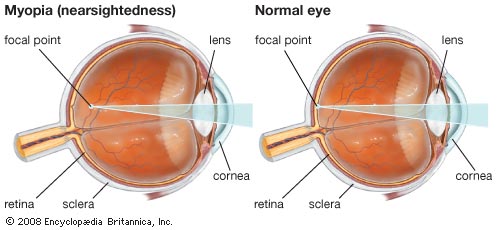
Myopia is caused when light is focused in the eye in front of the retina rather than on the retina.
If you are myopic you will see better up close than at far distances. Myopia often develops in children and may progress as they grow. It is corrected using concave spectacle or contact lenses.
Myopia Control:
It is estimated that by 2050 half the global population will be affected by myopia.
There are several theories regarding myopia development with no exact mechanism. It is widely accepted that a mixture of environmental and genetic factors are involved.
There is a greater chance of sight threatening complications particularly in people with higher amounts of myopia. For this reason it is important that especially where a child has two parents who are myopic, efforts are made to reduce the progression of myopia in children.
Methods used to try to control the progression of myopia include:
MiSight dual focus soft contact lenses are specifically designed to control myopia progression. Recent studies show that this reduction in progression of myopia may be as much as 50%. MiSight contact lenses are available at Devonport and Birkenhead Optometrists. The cost of these contact lenses is $159.00 per box of 90 lenses.
Pharmaceuticals. Low dose atropin eye drops shows promise in slowing progression of myopia.
Spectacle Lenses. Bifocal and progressive lenses may be used and show promise in reducing myopia progression. Hoya MyoSmart lenses are not yet available in New Zealand. Studies claim a reduction in up to 50% progression of myopia when using these spectacle lenses. The lens is designed with a central optical zone and multiple defocus segments surrounding this central zone.
Lifestyle changes. Studies show that children who spend more time outdoors exhibit less myopia progression when compared to less active children. It is also thought that light intensity may play a role in reducing myopia progression.
Hyperopia (Long Sighted)
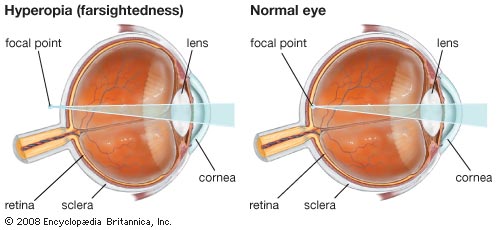
Hyperopia is the result of the visual image being focused behind the retina rather than directly on it. A farsighted person sees faraway objects clearer , while objects that are near are blurred or may cause eye strain. This often becomes more of a problem as we age.
Farsightedness is often present from birth. Children can often tolerate moderate amounts of farsightedness without difficulty, however farsightedness may result in learning difficulties, a “lazy” eye in the case where the eyes have different degrees of farsightedness, or an intermittent or constant inward “squint”.
It is important to have children tested for eye conditions as early as possible.
Farsightedness is corrected using convex spectacle or contact lenses.
Astigmatism
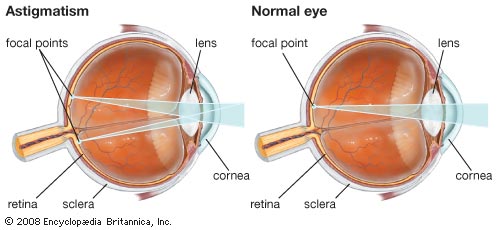
In astigmatism the cornea has different curvatures, rather like the surface of a rugby ball. This gives a blurred distance and reading image.
Astigmatism can occur by itself, but more usually it is associated with short or long-sightedness.
Astigmatism is corrected using spectacle lenses, rigid or soft toric contact lenses.
Presbyopia
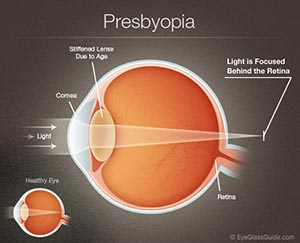
As we age the lenses in our eyes become less flexible.
This causes problems with close up focus and convex spectacles or contact lenses are used to correct this problem.
Glaucoma
Glaucoma symptoms may be difficult to spot, so it’s important to know when you’re at risk, and what to look out for.
Glaucoma is often called the silent or sneak thief of the sight, because it affects your vision gradually, often without being noticed. If left untreated, it can eventually cause total blindness. It is one of the leading causes of blindness in New Zealand.
The progression of glaucoma can be controlled with ongoing treatment. Because early detection of glaucoma is so important, regular eye examinations are advised. If you are over 40 one should have a two yearly eye examination and if one has a family history of glaucoma a yearly eye examination is advised.
At Birkenhead Optometrists we are able to perform goldmann tonometry, digital retinal photography and we have an automated visual field perimeter. All important in the detection and monitoring of glaucoma.
Dry Eye:
Dry eye is a common cause of chronic eye irritation.
It is caused by a chronic lack of sufficient lubrication and moisture on the surface of the eye. Symptoms may range range from subtle eye irritation to significant inflammation of the front surface of the eye and include:
- Burning gritty eyes often associated with reading and computer use.
- Intermittent blurred vision
- Watery eyes – Although this may seem odd dryness of the eye’s surface sometimes leads to an over production of the watery component of your tears. This watery “reflex tearing” does not stay on the eye long enough to correct the underlying dry eye condition.
- Red eyes
- Heavy, fatigued eyes.
- Sensitivity to bright light.
What Causes Dry Eyes?
An adequate and consistent layer of tears on the surface of the eye is essential to keep your eyes healthy, comfortable and seeing well. Tears bathe the eye’s surface to keep it moist and wash away dust, debris and microorganisms.
A normal tear film consists of three important components:
- An oily (lipid) component
- A watery (aqueous) component
- A mucous-like (mucin) component
Each component of the tear film serves a critical purpose. For example, tear lipids help reduce evaporation of tears, while mucin helps anchor and spread the tears across the surface of the eye.
Each tear component is produced by different glands on or near the eye:
- The oily component is produced by meibomian glands in the eyelids.
- The watery component is produced by lacrimal glands located above the upper, outer aspect of the upper eyelids.
- The mucin component is produced by goblet cells in the conjunctiva that covers the white of the eye (sclera).A problem with any of these sources of tear film or an external envionmental factor may result in tear instability and dry eyes.Factors affecting the source of tear film:
- The most common cause of increased evaporation of tears is meibomian gland dysfunction. Meibomian glands are located along the lid margin and supply the oily component to tears thereby reducing tear evaporation. If these glands become blocked the tear layer becomes unstable and the lid margins irritated.
Hot lid massage on an ongoing basis is often the best treatment for meibomian gland dysfunction. - Reduced tear film volume may be related to factors such as increased age, diabetes, female gender, diet and intake of beverages such as coffee, auto immune medical conditions as well as medication being taken.
Inreased fluid intake, omega 3 supplements as well as tear supplements in the form of dry eye drops are the best treatment for low tear film volume. - Environmental factors such as computer work which is related to a decrease in blink rate may be linked to dry eye symptoms. Air conditioners and heat pumps may also play a role.
Dry eye is a common problem that can usually be improved significantly by correct management. A professional consultation with an optometrist is the best way to diagnose the underlying cause and to begin the appropriate treatment. It’s important to understand that dry eye treatments often involve steps to relieve symptoms and manage the condition. It’s rare to be able to cure dry eye completely & permanently and ongoing treatment is often required.
Contact lenses
We stock and supply an extensive range of contact lenses. These can be ordered online or in store. We are often able to match the cheapest New Zealand contact lens internet sites.No courier fees within New Zealand apply. Either click on our Shop tab or look at https://contactlensesonline.co.nz/
Spectacle Frames and Prescription Sunglasses
Our frames are our pride and joy. We take pleasure in finding the perfect spectacle frame for your face. We stock many spectacle frame brands such as Calvin Klein, Prodesign, Rayban, Fendi, Cat, Silhouette, Adidas, Gucci, Maui Jim, Bill Bass and Dior in our practice.Where not available are happy to order any spectacle frame for your approval.
We have an ongoing offer with most of our sunglasses frames. This involves either free prescription single vision lenses or progressive tinted lenses at half their normal price.
Transition Lenses and How They Work?
If you’re thinking about getting transition lenses, consider this: Every time you do something as simple as walking out of a building, you could watch a chemical reaction happen literally right in front of your eyes.
Armed with chemical compounds that spring to action under ultraviolet light, transition lenses darken even on cloudy days to keep out those damaging rays. Then, when the coast is clear, they simply return to transparency.
Transition or “photochromic” glass was originally developed in the 1960s by Donald Stookey, a chemist at Corning Glass Works and a prolific inventor. (Stookey is most famous for discovering the super durable and extremely popular kitchenware material known as CorningWare, which he actually found accidentally after setting up a test reaction at 900°C instead of 600°C.) Soon after Stookey patented the material, Roger Araujo, another Corning chemist, used his breakthrough to develop the first photochromic lenses.
In 1965, Corning commercialized the first generation of transition lenses under the brand “Bestlite.” Three years later, these were dropped in favor of the more reliable Photogray lenses, named for their bluish gray hue when darkened. This color comes from the tiny amounts of the compound silver chloride (<0.1 percent) dispersed throughout the glass. When exposed to UVA light (315 nm – 400 nm), silver gains an electron from chloride to become silver metal, and gets the ability to absorb visible light and appear darker. They found that this reaction would work with any halogen or element from the same column in the periodic table as chlorine that is capable of giving away one electron to silver.
The same darkening process is also used for developing photographic film except that film exposure is permanent, while photochromic lenses possess another component, such as copper chloride, that helps silver return to its original, non-absorbing state once it’s away from UV light.
With the introduction of plastic lenses in the 1980s came the next generation of transition lenses based on thin films of organic compounds. These mostly carbon molecules—such as pyridobenzoxazines, naphthopyrans, and indenonaphthopyrans—react to UVA light by rearranging their chemical bonds into new species that can absorb and essentially block UV and visible light. Like tiny transformers, they can switch between either form depending on the presence or absence of UV light.
Plastic transition lenses are lighter and thinner than their glass counterparts, but their organic films are more susceptible to degradation than the silver halides used in glass.
But for both glass and plastic transition lenses, the darkening process happens almost instantaneously, while becoming clear takes anywhere from three to five minutes—which can be disorienting indoors. The clearing reaction is so much slower because it can’t rely on the driving energy of UV light. One trick to speeding up the reaction is to add heat energy by running the lenses underneath warm water.
Another inconvenience that can’t be avoided as easily comes from modern car windshields. Some are specially designed to filter out UV light, making it difficult for lenses to activate the darkening effect needed for driving.
Transition glasses may or may not be right for you, but they’re an excellent example of the everyday chemistry that’s happening in plain sight.
February 26, 2016 – 11:00pm